How to Sell Products Online in Nigeria: A Complete Guide
A practical, step-by-step guide to selling products online in Nigeria, from choosing a channel to getting paid and delivering orders.
CONTENT BRIEF
Primary keyword: how to sell products online in Nigeria Secondary keywords: how to sell online in Nigeria, selling products online in Nigeria, how to sell my products online, how to start an online business in Nigeria Search intent: Informational (pillar). Reader wants a complete roadmap, not a single tool pitch. Target audience: Nigerian SME owners and side-hustlers currently selling (or planning to sell) via WhatsApp, Instagram, or word-of-mouth, looking to formalize Recommended category: online-store Recommended tags: Nigeria, Online Store, Ecommerce, Small Business, WhatsApp, Payments, Logistics
SEO METADATA
Title: How to Sell Products Online in Nigeria: A Complete Guide Slug: how-to-sell-products-online-in-nigeria Excerpt: A practical, step-by-step guide to selling products online in Nigeria, from choosing a channel to getting paid and delivering orders. SEO title: How to Sell Products Online in Nigeria (Full Guide) SEO description: Learn how to sell products online in Nigeria: pick the right channel, accept payments, handle delivery, and build buyer trust. Step-by-step guide.
COVER IMAGE
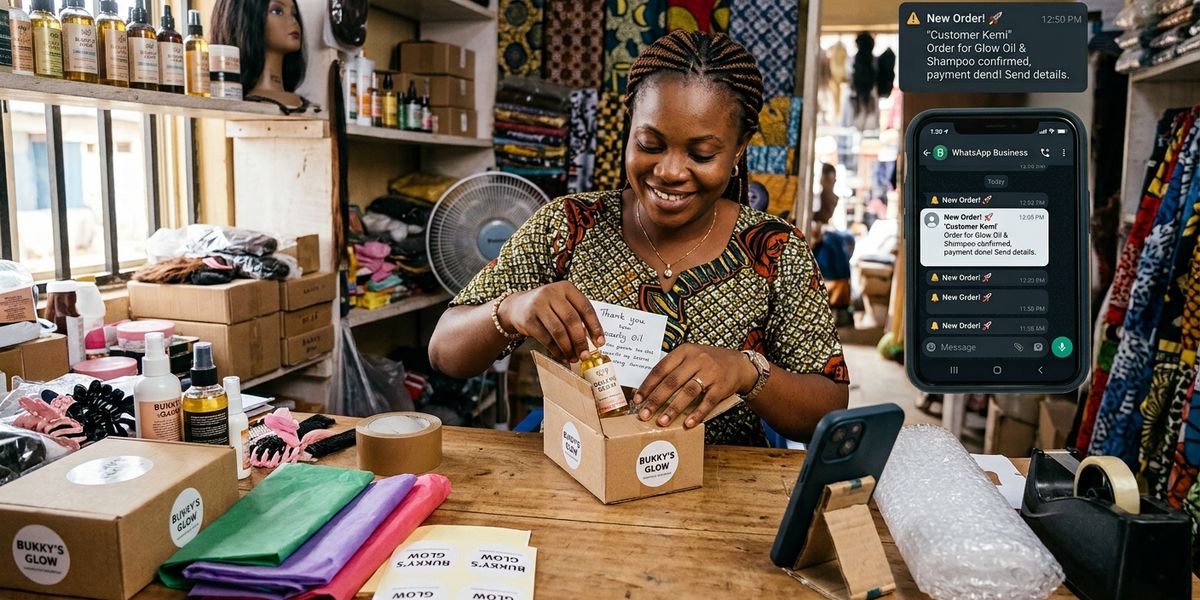
Concept: A Nigerian small business owner (fashion or beauty vendor) packaging a product at a small workspace, phone propped up showing a chat or order notification. Conveys "informal seller going online," not a stock-photo call center. Alt text: Nigerian small business owner packaging an online order for delivery Caption: Selling online in Nigeria starts with the basics, before you need any software.
ARTICLE
How to Sell Products Online in Nigeria: A Complete Guide
If you're already selling to friends, family, or WhatsApp status viewers, you've done the hardest part: you have something people want to buy. The harder question is how to turn that into a real, repeatable online business, one where strangers can find you, trust you, pay you, and get their order without twenty back-and-forth messages.
This guide walks through the actual decisions involved in selling products online in Nigeria: what to sell where, how to get paid, how to handle delivery, and how to avoid the mistakes that quietly kill new online sellers in their first few months.
Why Nigerian sellers are moving beyond "just WhatsApp status"
Posting products on WhatsApp Status or an Instagram feed works, until it doesn't. The typical breaking points look like this:
- You're retyping the same price and availability answers all day.
- Old posts with sold-out items keep resurfacing and confusing buyers.
- You have no simple way to track who has paid and who hasn't.
- A new customer can't easily see your full catalog. They only see whatever you posted that week.
None of this means WhatsApp or Instagram are bad for selling. They're often where Nigerian buyers actually are. The shift most sellers eventually make isn't away from these channels, it's toward pairing them with something more structured: a catalog or storefront that does the repetitive work so the chat can stay for the parts that need a human.
Step 1: Get clear on what you're selling and to whom
Before picking any platform, answer three questions honestly:
- Who buys from you today? Repeat customers, cold traffic from ads, or referrals?
- Is your catalog small and stable, or does it change weekly? (Fashion resellers often restock fast; made-to-order vendors don't.)
- Do people need to see or feel the product before buying, or do they trust photos and reviews?
Your answers shape everything downstream. A vendor with 15 fast-moving SKUs needs different tools than someone selling made-to-order aso-oke.
Step 2: Choose where you'll sell
Most Nigerian sellers end up combining two or three of the following rather than picking just one.
Still the default first channel for a huge share of Nigerian commerce, because that's where the conversation already happens. The limitation is structural: WhatsApp's native catalog is basic, there's no proper checkout, and you're manually tracking orders in your head or a notebook. If WhatsApp is your main channel, it's worth reading about https://zerrar.com/blog/how-to-set-up-whatsapp-business-for-your-online-store-step-by-step that layers a real catalog and order flow on top of the chats you're already having.
Instagram and Facebook
Good for discovery and visual browsing, weaker for closing the sale. Most Instagram "shops" still funnel buyers into DMs anyway. If this is a big part of your traffic, see https://zerrar.com/blog/how-to-add-multiple-agents-manage-whatsapp-business-inbox.
A dedicated online store
Gives you one link you control for your bio, your ads, and your business card, instead of depending entirely on a social platform's algorithm. This matters more as your business grows, because you own the storefront and the customer list.
Marketplaces
Useful for reach, but you're competing on price in a crowded listing and usually can't build a direct relationship with the buyer.
The realistic setup for most Nigerian sellers today is this: keep selling on WhatsApp and Instagram where your customers already are, but back it with one central storefront that holds your full catalog, so every channel points to the same organized place instead of a scattered mess of screenshots.
Step 3: Set up how you'll get paid
This is where a lot of otherwise-good businesses lose money to confusion or fraud. In Nigeria, buyers expect a mix of:
- Card payments. Fast for the buyer, but you need a proper payment gateway integration, not a shared personal account link.
- Bank transfer. Still dominant for many transactions, especially higher-value ones, but manual transfers are hard to verify and reconcile at volume.
- Payment links. A single link you send that lets the buyer choose card, transfer, or USSD, which removes a lot of the "I don close the payment page" friction.
Whatever you choose, the goal is the same: reduce the number of steps between "I want this" and "I've paid for this," and make sure you can actually confirm payment before you ship. For a full breakdown of the options, see https://zerrar.com/blog/how-to-create-paystack-account-accept-payments-nigeria.
Step 4: Sort out delivery before you take your first order
Delivery is where new sellers most often get burned, whether by unreliable riders, unclear pricing, or customers who refuse delivery on arrival ("send money before I open the door" disputes). Before you scale past friends-and-family orders, you need:
- A clear delivery pricing structure (flat rate, by zone, or by weight)
- A stated delivery timeframe you can actually meet
- A policy for what happens if a customer isn't reachable or refuses the item
- At least one reliable logistics partner, ideally two, for redundancy
This deserves its own deep dive. See https://app.zerrar.com for a full walkthrough of the logistics side.
Step 5: Build the kind of trust that gets you repeat customers
Nigerian online buyers have been burned before, so trust isn't automatic. You build it in small, visible ways:
- Show real product photos, not just supplier stock images
- State your return or exchange policy clearly, even if it's simple
- Confirm orders and payment in writing, not just verbally
- Avoid asking for payment through unusual or unverifiable channels
- Keep a record of every transaction. This protects you as much as the buyer.
None of this needs to be elaborate. A seller who answers clearly, ships what was promised, and handles problems without disappearing will outperform a flashier storefront with none of that discipline.
Common mistakes new online sellers make in Nigeria
- Selling only where you post, with no central catalog. Every new customer has to scroll your entire page history to see what you sell.
- No system for tracking orders and payments. This is manageable at 5 orders a week and unmanageable at 50.
- Underpricing delivery. Quoting a delivery fee that doesn't reflect actual cost, then absorbing the loss quietly.
- Mixing personal and business payment accounts. Makes it hard to track real profit and looks less professional to buyers.
- Going all-in on one channel. If your only presence is one Instagram account and it gets restricted, your business disappears with it.
Which setup is actually right for you?
A rough guide, based on where most sellers are:
- Just starting, low order volume: Stay on WhatsApp and Instagram, but organize your catalog and pricing so you're not retyping the same answers daily.
- Getting steady orders but drowning in manual work: This is the point to add a proper catalog and order system. You're past the stage where a notebook and memory are enough.
- Selling across WhatsApp, Instagram, and word-of-mouth simultaneously: You need one place that unifies all three so stock and pricing stay consistent everywhere. See https:app.zerrar.com.
- Ready to look properly established: A dedicated storefront with your own link, plus integrated payments and delivery tracking, is the natural next step.
Where Zerrar fits into this
Zerrar is built around this exact reality: most Nigerian sellers aren't choosing between WhatsApp and a website, they're trying to run both without doing double the work. It gives you a catalog and storefront that connects to the channels you're already selling on, with orders and payments tracked in one place instead of scattered across chats. If you're at the point where manual tracking has become the bottleneck, you can https:app.zerrar.com and bring your existing catalog in rather than starting from zero.
Frequently Asked Questions
Do I need a website to sell online in Nigeria? No. Many sellers do well on WhatsApp and Instagram alone. A dedicated storefront becomes more useful once your catalog grows or you want a single link you fully control, independent of any one social platform.
What's the cheapest way to start selling online in Nigeria? Starting on WhatsApp and Instagram costs nothing beyond your time. Costs come in later, through payment gateway fees, delivery, and any tools you add to manage orders at scale.
How do I accept payments if I don't have a registered business? Many Nigerian payment providers support individual or sole-proprietor accounts, though verification requirements vary by provider. It's worth checking documentation requirements directly with your chosen payment partner before you rely on it for live sales.
How do I stop customers from disappearing after asking "how much"? This usually comes down to friction. If pricing and buying require several messages back and forth, some buyers drop off. A visible price list or catalog people can browse before messaging you tends to reduce this.
Should I sell on Jumia or Konga instead of building my own presence? Marketplaces can add reach, but you're competing on price and don't own the customer relationship. Many sellers use marketplaces alongside, not instead of, their own storefront and social channels.
Conclusion
Selling online in Nigeria isn't really about picking the "right" platform. It comes down to removing friction at every step: how buyers find your catalog, how they pay you, how their order gets to them, and whether they trust you enough to buy again. Get those four things working together, on whatever channels your customers already use, and the sales follow.
CTA
Already selling through WhatsApp or Instagram but tired of managing everything by hand? You can sign up on Zeraar https:app.zerrar.com and bring your products, orders, and payments into one place, without abandoning the channels your customers already know.