How to Accept Online Payments in Nigeria (Full Guide)
A practical guide to accepting online payments in Nigeria: card, bank transfer, USSD, and payment links, and how to pick what fits your business.
How to Accept Online Payments in Nigeria: Full Guide
Making a sale is only half the job. If payment collection is slow, confusing, or easy to fake, you either lose the sale at the last step or ship a product you were never actually paid for. This guide covers the realistic payment options available to Nigerian sellers, where each one fits, and the mistakes that cost sellers money.
The main ways Nigerian buyers pay online
Most Nigerian online transactions happen through one of these:
Bank transfer
Still the most familiar and trusted method for a large share of Nigerian buyers, especially for higher-value purchases. The downside is verification: a screenshot isn't proof of a successful transfer, and manually checking your bank app against every order doesn't scale past a small volume of sales.
Card payments
Fast for the buyer once set up, but you need a proper payment gateway to accept them safely and legally. Sharing a personal account number for a "card payment" isn't how this works; you need an integration through a licensed payment processor.
USSD
Useful for buyers without a smartphone banking app or reliable data at the moment of purchase. Many Nigerian payment gateways support USSD as one option alongside card and transfer.
Payment links
A single link you send (via WhatsApp, Instagram DM, email, or SMS) that lets the buyer choose how they want to pay: card, transfer, or USSD, all in one flow. This removes a lot of friction compared to negotiating "please send to this account" back and forth.
Step 1: Decide if you need a payment gateway
If you're taking a handful of orders a week and your buyers are comfortable with manual bank transfer plus a screenshot, you might not need a gateway yet. That changes once:
- You're spending real time each day verifying transfers manually
- Buyers ask for card payment and you have no way to offer it
- You want to reduce the number of "sent but not received" disputes
- You're scaling past what you can track by memory or a notebook
A payment gateway (Paystack, Flutterwave, Moniepoint, and Monnify are among the widely used options in Nigeria) handles the actual processing, verification, and settlement for you, so you're not relying on manually cross-checking your bank alerts.
Step 2: Understand what a gateway actually gives you
A payment gateway typically provides:
- A checkout page or payment link you can share directly
- Support for multiple payment methods (card, transfer, USSD) in one flow
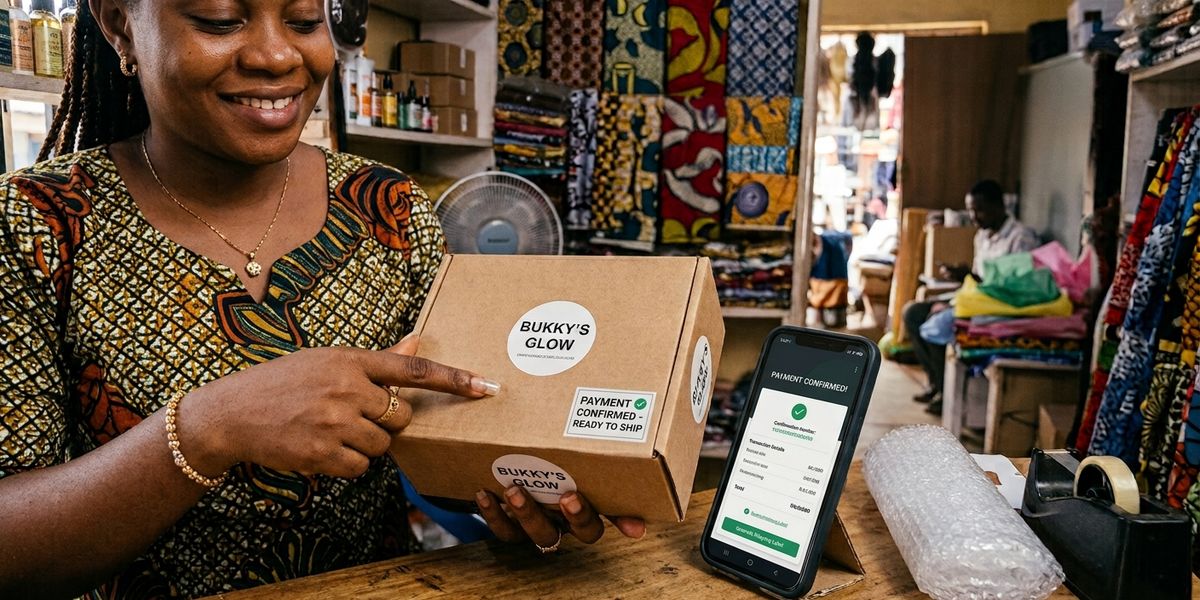
- Automatic confirmation when payment succeeds, instead of manual verification
- A dashboard showing your transaction history
This matters most for the confirmation piece. Instead of asking "did you send it?" and waiting for a screenshot, you get a system-level confirmation the moment payment clears.
Step 3: Choose based on how you sell, not just fees
Sellers often compare gateways purely on transaction fees, but the more important question is fit:
- Selling mostly through WhatsApp or Instagram DMs? A payment link you can paste into a chat matters more than a full checkout page.
- Running a dedicated online store? You'll want a gateway that integrates directly into your storefront's checkout, not just a standalone link.
- Taking occasional large orders? Confirm the gateway supports higher transaction limits without extra friction.
Whatever you choose, always check settlement time (how fast the money actually reaches your account) since this varies by provider and can affect your cash flow.
Step 4: Set expectations with buyers clearly
However you collect payment, be explicit with customers about:
- What counts as confirmed payment (a bank alert to you, not just a screenshot from them)
- When you'll ship after payment is confirmed
- What happens if payment fails or is reversed
This reduces disputes and protects you from the small number of buyers who try to claim they paid when a transfer hasn't actually cleared.
Common mistakes Nigerian sellers make with payments
- Accepting only bank transfer with screenshot as proof. Screenshots can be faked or come from failed transactions. Always verify against your actual bank alert or gateway dashboard.
- Mixing personal and business accounts. This makes it nearly impossible to track real revenue and looks less credible to buyers who check the account name.
- Not confirming payment before shipping. Ship only after you've verified the money has actually landed, not just that a message says it was sent.
- Ignoring settlement delays. Some methods take longer to reflect in your account; plan your cash flow around this instead of being surprised by it.
- Making payment harder than it needs to be. Asking a buyer to navigate multiple steps to pay you loses sales at the finish line.
How Zerrar fits in
Zerrar connects directly to payment processors including Paystack, Moniepoint, Flutterwave, and Monnify, so orders placed through your storefront or WhatsApp catalog can be paid for and automatically confirmed, without you manually checking a bank app against every order. If manual payment tracking has become the bottleneck in your business, you can set up your store's payments on Zerrar and connect a gateway directly to your catalog.
Frequently Asked Questions
Do I need a registered business to accept online payments in Nigeria? Requirements vary by provider. Some payment gateways support individual or sole-proprietor accounts, while others require registered business documentation for higher transaction limits. Check directly with your chosen provider before relying on it for live sales.
Is bank transfer still safe to accept? Yes, as long as you verify the transfer actually landed in your account rather than trusting a screenshot alone. It's most reliable at lower order volumes where manual checking is still practical.
What's the difference between a payment gateway and a payment link? A payment gateway is the underlying system that processes the transaction. A payment link is a simple, shareable way to send a customer to that gateway's checkout without needing a full website.
How long does it take for payments to settle into my account? This depends on the provider and payment method used. Check your specific gateway's settlement schedule so you can plan cash flow accordingly.
Can I accept both card and transfer through one link? Most Nigerian payment gateways support multiple payment methods through a single checkout or payment link, letting the buyer choose at the point of payment.
Conclusion
Getting paid reliably in Nigeria comes down to reducing manual verification and giving buyers an easy way to pay however they prefer. Whether that's a full gateway integration or a simple payment link depends on your order volume and how you sell, but the goal is the same either way: confirm payment fast, ship with confidence, and stop losing time to screenshot-checking.
Still verifying bank transfers by hand? Connect your payments on Zerrar and get automatic confirmation the moment an order is paid for, whatever channel it came through.