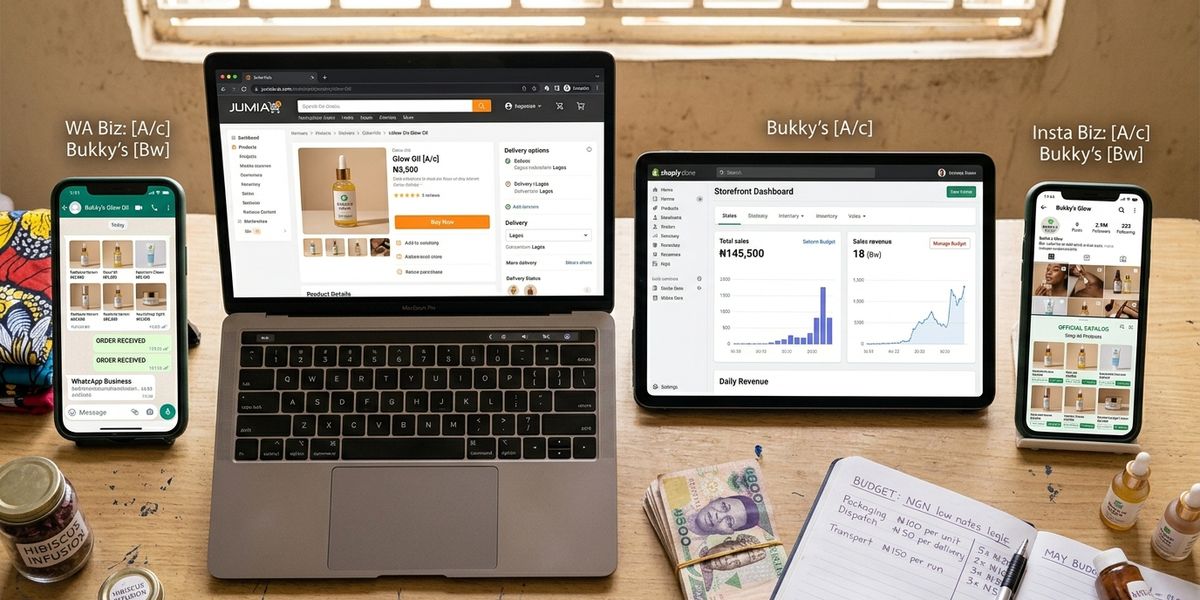
Best Online Store Platforms for Small Businesses in Nigeria
An honest comparison of the main options for building an online store in Nigeria, marketplaces, global platforms, and Nigeria-built builders, and who each suits.
Best Online Store Platforms for Small Businesses in Nigeria
There's no single "best" online store platform in Nigeria, only the one that fits how you sell, what you sell, and how much control you want over your brand and customer relationships. This guide compares the main categories of platforms available to Nigerian sellers today, what each does well, and who they actually suit, so you can make an informed choice rather than picking based on marketing alone.
What actually matters when choosing a platform
Before comparing specific options, it helps to be clear on what you're weighing:
- Commission versus subscription. Marketplaces typically take a percentage of every sale instead of (or alongside) a monthly fee. Store builders usually charge a flat subscription and let you keep the full sale price.
- Control over your brand and customer data. A marketplace listing belongs partly to that marketplace. A store you build yourself is entirely yours, including the customer relationships.
- Local payment support. Whether Naira transfers, USSD, and Nigerian payment gateways are built in, or something you'd need to set up separately.
- Ease of setup. Whether you need technical skills or can set everything up yourself through simple forms.
Marketplaces: Jumia and Konga
Jumia and Konga are established Nigerian marketplaces with large existing buyer traffic. You list your products and they handle discovery, and in some cases logistics.
How they charge: Jumia doesn't charge a subscription fee but takes a commission per sale that varies by product category, commonly cited in a wide range depending on category. Konga combines a monthly plan with a commission that's generally lower, often cited as starting around 3%, though this also varies by category.
What you get: Access to a large, existing buyer base without needing to drive your own traffic, plus logistics support in many cases.
What you give up: Limited control over how your product page looks, no direct ownership of the customer relationship, and your margins are affected by commission on every sale.
Best for: Sellers who want fast access to buyer traffic and are comfortable trading some brand control and margin for that reach, particularly in categories like electronics and fashion where these marketplaces have strong existing traffic.
Global platforms: Shopify
Shopify is one of the most established ecommerce platforms globally, with a large ecosystem of themes, apps, and integrations.
How it charges: Shopify's pricing is in US Dollars, with plans starting at a low monthly cost and scaling up for more advanced features and higher-volume stores.
What you get: A highly customizable storefront, a large app marketplace, and tools built for businesses that may sell internationally, not just within Nigeria.
What you give up: Nigerian payment gateways like Paystack or Flutterwave typically need to be added as third-party integrations rather than working natively out of the box, and pricing in USD means your costs move with the exchange rate.
Best for: Sellers building a brand aimed partly or fully at international customers, or who want deep customization and are comfortable managing a slightly more involved setup.
Nigeria-built platforms: Bumpa and others
A newer category of platforms has been built specifically for the Nigerian market, with Naira pricing, local payment integrations, and WhatsApp-centered selling built in from the start. Bumpa is one of the more established examples, offering a free tier and paid plans, with features including a storefront, inventory management, POS for in-person sales, and WhatsApp order notifications.
What this category generally gets right: Naira-denominated pricing, payment gateways that work without extra setup, and features shaped around how Nigerian sellers actually operate, WhatsApp-first selling, local delivery partners, and simple onboarding without needing technical skills.
What varies between them: Feature depth differs significantly from platform to platform, so it's worth checking specifically what each includes at your intended plan level, particularly around staff accounts, branch management, and financial reporting, since these vary the most between platforms in this category.
Best for: Sellers focused primarily on the Nigerian market who want local payment and logistics support without configuring it themselves, and who value a setup process built around WhatsApp and Naira from the ground up.
WhatsApp and Instagram's native tools
Worth including because they're genuinely where many Nigerian sellers start. WhatsApp Business's native catalog and Instagram's shopping features are free and require no separate platform at all.
What you get: Zero cost, and you're exactly where a large share of Nigerian buyers already are.
What you give up: No real checkout, limited catalog depth, and no order tracking or analytics beyond what you track manually. See WhatsApp Business vs an online store for a full breakdown of where this approach starts to show its limits.
Best for: Sellers just starting out, testing a product idea, or operating at low order volume where manual tracking is still manageable.
Where Zerrar fits into this comparison
Zerrar falls into the Nigeria-built category: a storefront and catalog connected directly to WhatsApp, with Paystack, Moniepoint, Flutterwave, and Monnify payment integrations built in, along with logistics connections to partners like GIG Logistics, Fez, Sendbox, and Kwik. Pricing runs on Naira-denominated monthly plans, starting with a free 15-day trial and paid tiers from ₦8,000 a month. It isn't automatically the right fit for every seller listed here, a marketplace may still make more sense for a seller purely chasing reach, and Shopify may suit a brand building for international buyers, but for a Nigerian seller who wants their catalog, WhatsApp orders, payments, and delivery working together without separate setup, it's built specifically for that use case. You can compare Zerrar's plans directly against your current setup.
How to actually decide
- Chasing reach above all else, comfortable with commission and less brand control: A marketplace like Jumia or Konga.
- Building toward an international customer base or need deep customization: Shopify, accepting the added setup for Nigerian payments.
- Focused on the Nigerian market, want local payments and WhatsApp selling built in from day one: A Nigeria-built platform, comparing feature depth and pricing across the specific ones available.
- Just starting out, testing whether a product sells at all: WhatsApp and Instagram's free tools, until order volume justifies more structure.
Many sellers end up combining approaches, listing on a marketplace for reach while running their own store for brand-building and better margins, rather than treating this as an exclusive choice.
Frequently Asked Questions
Is a marketplace or a dedicated store better for a new Nigerian seller? It depends on your priority. A marketplace gets you in front of existing buyer traffic faster; a dedicated store gives you more control over branding and margin. Many sellers eventually use both.
Is Shopify a good fit for Nigerian sellers? It can be, particularly for sellers with international ambitions or existing technical comfort. Nigerian payment gateways typically require additional setup compared to Nigeria-built platforms where they're integrated natively.
How much commission do Jumia and Konga charge? Both charge commission that varies by product category. Jumia doesn't charge a subscription fee alongside its commission, while Konga combines a monthly plan with commission. Check each platform's current seller terms directly, as rates vary and change over time.
Do I have to choose only one platform? No. Many Nigerian sellers use a marketplace for reach alongside their own storefront for brand-building, repeat customers, and better margins.
What's the main advantage of a Nigeria-built platform over a global one like Shopify? Local payment gateways, Naira pricing, and features built around how Nigerian sellers actually operate, particularly WhatsApp-first selling, tend to work without the extra integration setup a global platform often requires.
Conclusion
The right platform depends on what you're optimizing for: reach, brand control, international ambition, or a setup that works with Nigerian payments and WhatsApp selling out of the box. None of these options is universally best. Match the platform to your actual priorities, and don't be afraid to use more than one as your business grows.
Focused on the Nigerian market and want payments, WhatsApp, and delivery working together without separate setup? Compare Zerrar's plans and see if it fits how you sell.